Face Wash vs Face Scrub: Why Scrubbing Rarely Helps
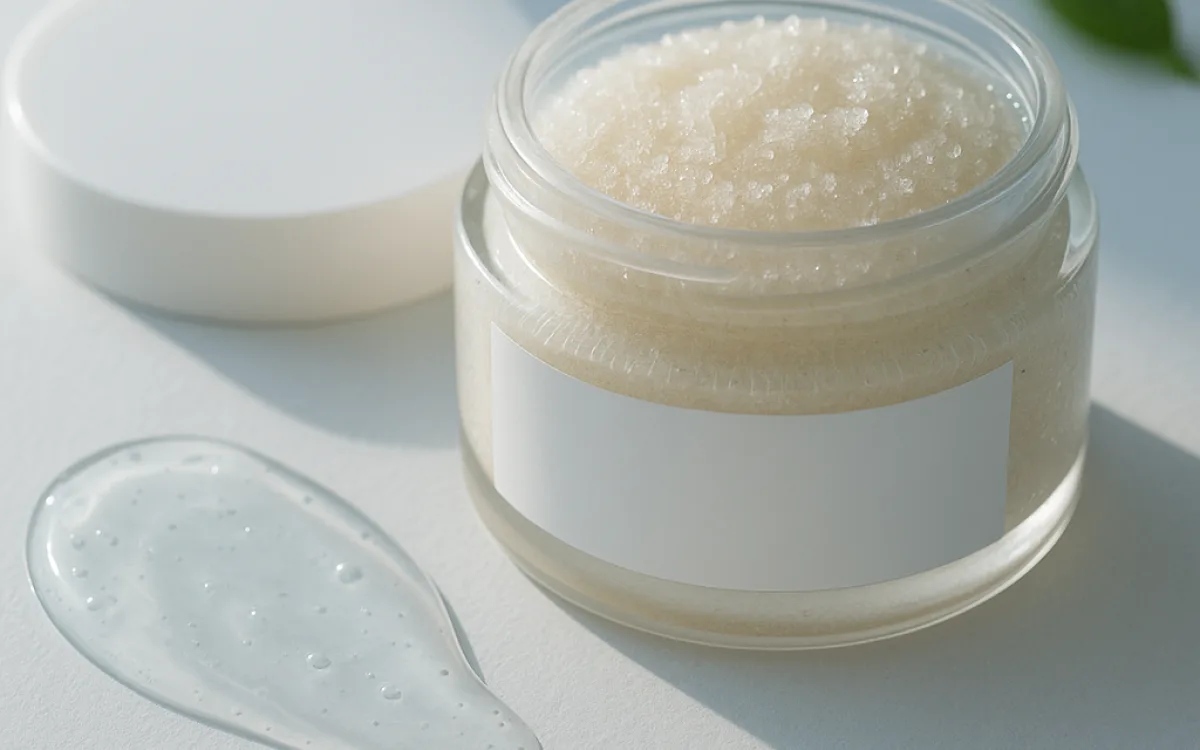
A face scrub gives immediate feedback. Skin feels smooth straight afterwards, and that sensation is persuasive enough that scrubs have survived decades of evidence pointing the other way.
The smoothness is real. It is also temporary, and the cost is paid slowly.
What a scrub does and does not do#
- It removes loose dead cells from the very surface — genuine, but short-lived.
- It does not clear blackheads. A blackhead is a plug inside the pore and abrasion at the surface does not reach it.
- It does not reduce oil production.
- On inflamed acne it spreads bacteria and damages already fragile skin.
- With repetition it creates micro-tears that present as redness, sensitivity and roughness.
The sequence people describe most often: scrub, skin feels smooth, skin gets rough within days, scrub again. That loop is barrier damage, not exfoliation need.
Physical versus chemical exfoliation#
| Physical scrub | Chemical exfoliant | |
|---|---|---|
| How it works | Abrasion | Loosens the bonds between dead cells |
| Control over depth | Poor — depends on pressure | Precise — set by concentration and pH |
| Reaches inside pores | No | Salicylic acid does |
| Risk of micro-tears | Real | Minimal |
| Immediate feel | Very smooth | Little sensation |
| Result after 6 weeks | Often rougher | Smoother, more even |
If you like the ritual, do it safely#
There is nothing wrong with occasional physical exfoliation on resilient skin. The mistakes are frequency and pressure.
- Once a week at most, and never on inflamed or broken skin.
- Choose smooth, rounded particles — jojoba beads, rice powder — rather than crushed shell or stone.
- Use no pressure. Let the particles do the work in a few light circles for fifteen seconds.
- Skip it entirely for a fortnight if your skin is stinging, flaking or red.
- Never combine it with an acid or a retinoid in the same session.
What to use instead#
For blackheads and congestion, salicylic acid — a wash a few times a week, or better, a leave-on. For dullness and uneven texture, a low-strength lactic or mandelic acid twice a week. For everything else, a gentle cleanser and time. Skin exfoliates itself on a roughly twenty-eight day cycle; the job is to help that, not to override it.
Cleansing brushes and cloths#
The same logic applies. A soft muslin cloth used lightly a couple of times a week is mild physical exfoliation and is fine for most skin. A motorised brush used twice daily is a scrub that never stops, and it is a frequent cause of the sensitivity that people then treat with more products.
Frequently asked questions
Is a face scrub bad for skin?
Not inherently, but the way most people use them is. Weekly, with no pressure, on resilient skin that is not inflamed, a gentle scrub is fine. Daily scrubbing, or scrubbing over active acne, causes more problems than it solves.
Do scrubs remove blackheads?
No. A blackhead is a plug of sebum and dead cells inside the pore, and surface abrasion does not reach it. Salicylic acid works there because it is oil-soluble and can travel into the pore.
Should I use a face scrub or a chemical exfoliant?
A chemical exfoliant for almost every goal — it gives control over depth, does not tear the surface, and salicylic acid reaches inside the pore. A physical scrub is a texture preference, used sparingly.
face wash vs face scrubis face scrub badphysical vs chemical exfoliationhow to remove blackheadsexfoliating cleansercleansing brush